As workplaces become more flexible, height adjustable conference tables are finding their place in corporate offices, collaborative spaces, and executive meeting rooms. Unlike conventional fixed-height tables, these systems need to support large work surfaces, multiple users, and a range of electronic equipment while moving smoothly between sitting and standing positions. This puts greater demands on the design of the Height Adjustable Conference Table Frame. Stability affects more than just how much a tabletop moves or wobbles. It also plays a role in load distribution, lifting consistency, operational reliability, and long-term durability.
Large conference tables present challenges that standard standing desks do not. Their extended tabletops create longer support spans, while monitors, laptops, conferencing cameras, and other equipment add weight at different points. As the table rises, the lifting columns extend and the structure's center of gravity changes. Any weakness in the frame, column connections, or support arrangement can become more noticeable at greater heights.
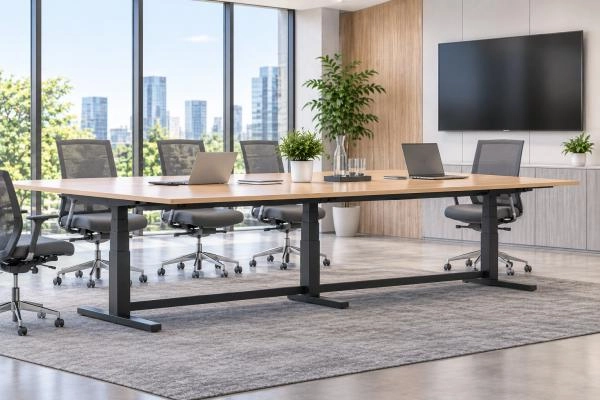
A well-designed frame keeps the tabletop properly supported throughout its adjustment range. It helps limit unwanted lateral movement, distributes loads across the supporting points, and provides a stable foundation for everyday use. For conference table manufacturers, however, maximum load capacity alone is not enough to determine whether a lifting system is suitable. Frame rigidity, tabletop dimensions, lifting range, and actual load distribution all deserve attention during the selection process.
Lifting columns are among the main load-bearing components of an electric height adjustment system. Their telescopic sections must extend and retract while supporting the tabletop and any equipment mounted on it. The design, fit, material quality, and alignment of these sections all influence performance, especially when the table approaches its maximum height.
Three-stage telescopic columns are useful when a conference table needs a wider height adjustment range without requiring an excessively tall fixed structure. However, the number of telescopic sections alone does not determine stability. The clearance between moving profiles, column rigidity, connection strength, and overall frame geometry also affect how the system performs.
Column alignment is another factor worth considering. If the lifting columns are incorrectly positioned or installed, the frame may experience uneven forces during movement. This can lead to inconsistent lifting, increased mechanical stress, or noticeable movement of the tabletop. Accurate installation and a properly matched frame configuration are essential for reliable operation over repeated adjustment cycles.
Load capacity is a key specification when choosing a heavy-duty electric conference table frame, but it should always be considered alongside weight distribution. A large tabletop may carry several displays, video conferencing equipment, power modules, and other accessories. Even if the combined weight falls within the specified capacity, concentrating equipment in one area can place uneven demands on the supporting structure.
For example, a conference table with most of its equipment positioned at one end may place different demands on the frame than one with equipment distributed evenly across the surface. The support structure must therefore suit the intended tabletop dimensions and equipment layout, not just meet a nominal load requirement.
Buyers should also distinguish between static load capacity and dynamic lifting performance. Supporting a stationary load and raising that load smoothly are two related but different requirements. A suitable frame design helps distribute forces through the supporting structure and into the lifting columns. Cross-supports, mounting connections, column positioning, and tabletop attachment points all need to be considered, particularly when developing oversized conference tables.
For OEM furniture manufacturers, confirming the expected load and equipment layout before production can help prevent problems such as excessive deflection, uneven movement, and premature component wear.
Frame width determines how well a lifting system can accommodate different tabletop sizes. A frame that is too narrow for the intended work surface may not provide suitable support, while poorly positioned support points can affect load distribution and overall rigidity. These issues become more relevant with large conference tables, where the distance between supporting points and the placement of equipment influence structural performance.
An adjustable-width frame gives furniture manufacturers more flexibility when developing different table configurations. Rather than requiring a completely different frame for every tabletop size, manufacturers can adjust the supporting structure within its specified range. This can simplify product development and expand the range of furniture designs that use the same lifting system.
However, frame width should always be adjusted according to the manufacturer's specifications. Buyers need to consider tabletop length, column positioning, support geometry, and mounting requirements together. Simply extending the frame to match a larger tabletop does not guarantee adequate stability.
In a multi-column electric lifting system, coordinated movement is essential. If the lifting points move at different speeds, the tabletop may become uneven, placing additional stress on the frame and mechanical components. Motor synchronization is therefore an important consideration when selecting a height adjustable conference table frame.
A suitable control system coordinates the lifting columns to maintain consistent movement. Buyers should look at starting and stopping behavior, lifting consistency, control responsiveness, and performance under the intended load. Memory presets can also be useful in shared meeting environments, allowing users to return to preferred working heights without repeated manual adjustments.
Safety features deserve attention as well. Depending on the control unit, functions such as overload protection, collision detection, and travel limits can help reduce the risk of equipment damage during operation. Buyers should confirm which features are included in the specific configuration rather than assuming they are standard across all electric lifting systems.
Operating noise is another practical consideration. Frequent height adjustments should not disrupt meetings or presentations. Motor design, gearbox construction, the lifting mechanism, column structure, and control settings can all influence noise levels and movement smoothness. A well-matched system should provide controlled adjustment without compromising the structural requirements of a large tabletop.
For commercial furniture buyers, frame stability should be assessed under realistic operating conditions rather than judged by appearance alone. One practical approach is to check the tabletop at several positions within its adjustment range, including minimum, intermediate, and maximum heights. Noticeable lateral movement, uneven alignment, or unusual vibration should be investigated before the system is approved for production or installation.
Load testing should reflect the table's intended use. Buyers need to account for the combined weight of the tabletop, displays, accessories, and other equipment. Both evenly distributed and off-center loading conditions may be relevant, depending on the final configuration. The manufacturer's specified load limits and test conditions should be reviewed rather than assuming that a high load rating guarantees stability in every application.
Connection quality is equally important. Loose fasteners, poorly fitted mounting plates, inaccurate column positioning, or unsuitable tabletop attachments can affect an otherwise capable lifting system. Correct assembly and regular inspection help maintain the intended structural performance. For manufacturers purchasing frames in volume, assembly instructions, technical documentation, and consistent production quality should also form part of the supplier evaluation.
Long-term performance depends on the operating conditions, too. Repeated lifting cycles place demands on both mechanical and electrical components. Buyers should review duty-cycle specifications, maintenance recommendations, and the availability of technical support before choosing a system for commercial use.
The DewertOkin DS3 / 180° Conference Desk is designed for large workstations and conference table applications. Its specifications address several requirements associated with oversized furniture, including adjustable frame width, an extended height range, and a high stated load capacity.
The system features a 1500N load capacity, a maximum lifting speed of 35 mm/s, and a height adjustment range of 600–1250 mm, providing a 650 mm adjustment stroke. Its frame width can be adjusted from 2200 mm to 3600 mm. The three-stage telescopic column design accommodates the extended lifting range, while the steel frame provides the supporting structure for large work surfaces.
These specifications make the system relevant to furniture manufacturers developing large conference tables, executive workstations, and collaborative office furniture. The adjustable frame width allows greater flexibility when matching the support structure to different tabletop configurations. Meanwhile, the height range gives users the option of switching between seated and standing positions. The maximum lifting speed of 35 mm/s also supports convenient adjustments in shared work environments.
When evaluating this system, buyers should consider the complete configuration, including tabletop weight, equipment placement, mounting dimensions, and intended operating conditions. The stated 1500N capacity should be assessed in accordance with the manufacturer's load-rating conditions. It should not be taken as a guarantee of identical performance under every load distribution or tabletop configuration.
Choosing a conference table lifting frame involves more than comparing specifications. Product engineering, component quality, assembly standards, and quality control all influence the consistency of the finished system. For OEM customers, a supplier's ability to provide compatible lifting columns, control units, handsets, and technical support can also make product development and integration easier.
DewertOkin Technology Group brings together the Dewert and OKIN brands and traces its history to Germany in 1982. According to its company information, the group operates production facilities across Asia, Europe, and the Americas. Its product capabilities include electric lifting systems, lifting columns, control units, and related components for adjustable furniture applications.
This product experience is relevant to conference table manufacturers looking for integrated electric adjustment solutions. Rather than treating the frame as a standalone steel structure, OEM buyers can assess how the mechanical support system works with the lifting columns and electronic controls. Taking this broader view helps ensure that the selected configuration matches the dimensions, load requirements, and intended use of the finished furniture.
The performance of a height adjustable conference table depends on several factors working together, including frame rigidity, telescopic column design, load distribution, motor synchronization, and installation quality. A system that performs well at its lowest position may behave differently when fully extended or carrying equipment concentrated in one area. Stability should therefore be assessed across the entire adjustment range and under conditions that reflect actual use.
For manufacturers and commercial furniture buyers, choosing the right Height Adjustable Conference Table Frame means looking beyond load capacity and lifting speed. Frame width, column configuration, control compatibility, tabletop dimensions, and long-term operating requirements all deserve consideration. With its adjustable frame width, three-stage telescopic structure, and 600–1250 mm height range, the DewertOkin DS3 / 180° Conference Desk is worth considering for large conference tables and flexible commercial workstations.